Continuous Flow Manufacturing: Key Concepts and Benefits
Discover how Continuous Flow Manufacturing (CFM) revolutionizes production efficiency and transforms traditional manufacturing processes. This comprehensive guide explores the essential principles, benefits, and implementation strategies of this innovative manufacturing approach.
Understanding Continuous Flow Manufacturing
Continuous Flow Manufacturing (CFM) represents a sophisticated production strategy focused on the uninterrupted movement of materials and products throughout the manufacturing process. Unlike traditional batch production methods, CFM creates a streamlined system where items move seamlessly from one workstation to the next without delays or interruptions. This approach significantly minimizes waste, reduces lead times, and enhances overall production efficiency.
CFM aligns closely with lean manufacturing principles by eliminating non-value-adding activities and optimizing workflows. By maintaining a constant flow of production, manufacturers can respond more quickly to market demands while reducing inventory costs and improving resource utilization. The system works particularly well in environments where consistent output and standardized processes are essential for operational success.
Historical Background and Evolution
The roots of Continuous Flow Manufacturing trace back to Henry Ford’s revolutionary assembly line concept in 1913. This innovation transformed manufacturing by introducing a moving assembly line where each worker performed specific tasks as the vehicle chassis moved through the factory. The breakthrough reduced Model T production time from 12 hours to just 93 minutes, demonstrating remarkable efficiency gains through continuous flow principles.
The concept evolved significantly with the Toyota Production System (TPS) in post-World War II Japan. Led by Taiichi Ohno and Eiji Toyoda, Toyota refined these principles into what would become the foundation of modern lean manufacturing. Their system incorporated:
- Just-in-time production methods
- Built-in quality mechanisms
- Continuous improvement (kaizen) practices
- Standardized work procedures
- Visual management systems
Key Elements of Continuous Flow Manufacturing
Successful CFM implementation relies on several critical elements working in harmony:
- Single-piece flow production lines
- Just-in-time (JIT) material delivery
- Automated processes calibrated to takt time
- Standardized work procedures
- Quick changeover capabilities
- Visual management systems
- Integrated quality controls
Benefits of Continuous Flow Manufacturing
Organizations implementing CFM experience substantial operational and financial advantages. The approach delivers:
| Benefit Area | Impact |
|---|---|
| Order-to-delivery timeframes | 50-70% reduction |
| Production cycle times | Up to 30% reduction |
| Work-in-progress inventory | 40-60% decrease |
| Overall Equipment Effectiveness (OEE) | Increase from 60-65% to 80-85% |
Efficiency and Cost Savings
The efficiency improvements through CFM translate into significant cost savings across operations. Enhanced throughput capacity particularly benefits high-volume production environments, where maximizing equipment utilization directly impacts profitability. The elimination of batch-related downtime increases machine efficiency rates, while streamlined processes require less factory floor space, reducing facility costs and creating opportunities for growth without physical expansion.
Quality Control and Employee Satisfaction
Continuous Flow Manufacturing integrates quality control directly into the production process, replacing traditional end-of-line inspections. This real-time feedback system enables workers to identify and address issues immediately, preventing defect propagation. The approach typically achieves a 70-90% reduction in defect rates compared to batch manufacturing methods, while ensuring greater product consistency and reliability. This enhanced quality control leads to improved customer satisfaction and lower warranty costs.
The impact of CFM on employee satisfaction extends beyond quality improvements. The system creates a more ergonomic work environment by:
- Eliminating physical strain from handling large batches
- Providing immediate visibility of work results
- Empowering workers with quality control responsibility
- Fostering continuous improvement participation
- Creating opportunities for process refinement input
Challenges in Implementing Continuous Flow Manufacturing
The transition to Continuous Flow Manufacturing presents significant challenges that require careful consideration. Organizations face substantial hurdles in two primary areas:
| Challenge Area | Key Considerations |
|---|---|
| Financial Investment | Specialized equipment costs, automation systems, software implementation, production line reconfiguration |
| Human Resources | Staff training requirements, recruitment of skilled personnel, cultural adaptation to flow thinking |
Addressing Bottlenecks and Downtime
Bottlenecks in Continuous Flow Manufacturing require sophisticated monitoring and analysis to identify constraint points. Organizations implement value stream mapping and Theory of Constraints methodologies to systematically address these challenges. Solutions often include capacity additions, workflow redesigns, and targeted automation implementations.
Unplanned downtime management requires:
- Robust preventive maintenance programs
- Quick response protocols for equipment failures
- Autonomous maintenance by operators
- Advanced production planning systems
- Contingency protocols for critical equipment
Ensuring Raw Material Availability
Maintaining uninterrupted material flow requires sophisticated supply chain coordination. Successful organizations achieve this through:
- Electronic data interchange (EDI) systems integration
- Vendor-managed inventory arrangements
- Multi-tier supplier qualification programs
- Strategic supplier parks establishment
- Dual-sourcing strategies for critical components
- Advanced analytics for supply disruption prediction
The Role of Technology in Continuous Flow Manufacturing
Digital solutions have revolutionized Continuous Flow Manufacturing, enabling unprecedented levels of coordination and control. Modern CFM systems leverage technology for real-time data collection, production monitoring, and seamless communication across the value chain. This technological integration has expanded CFM’s applicability across diverse industries, from automotive and electronics to consumer goods and pharmaceuticals.
Leveraging Digital Technologies
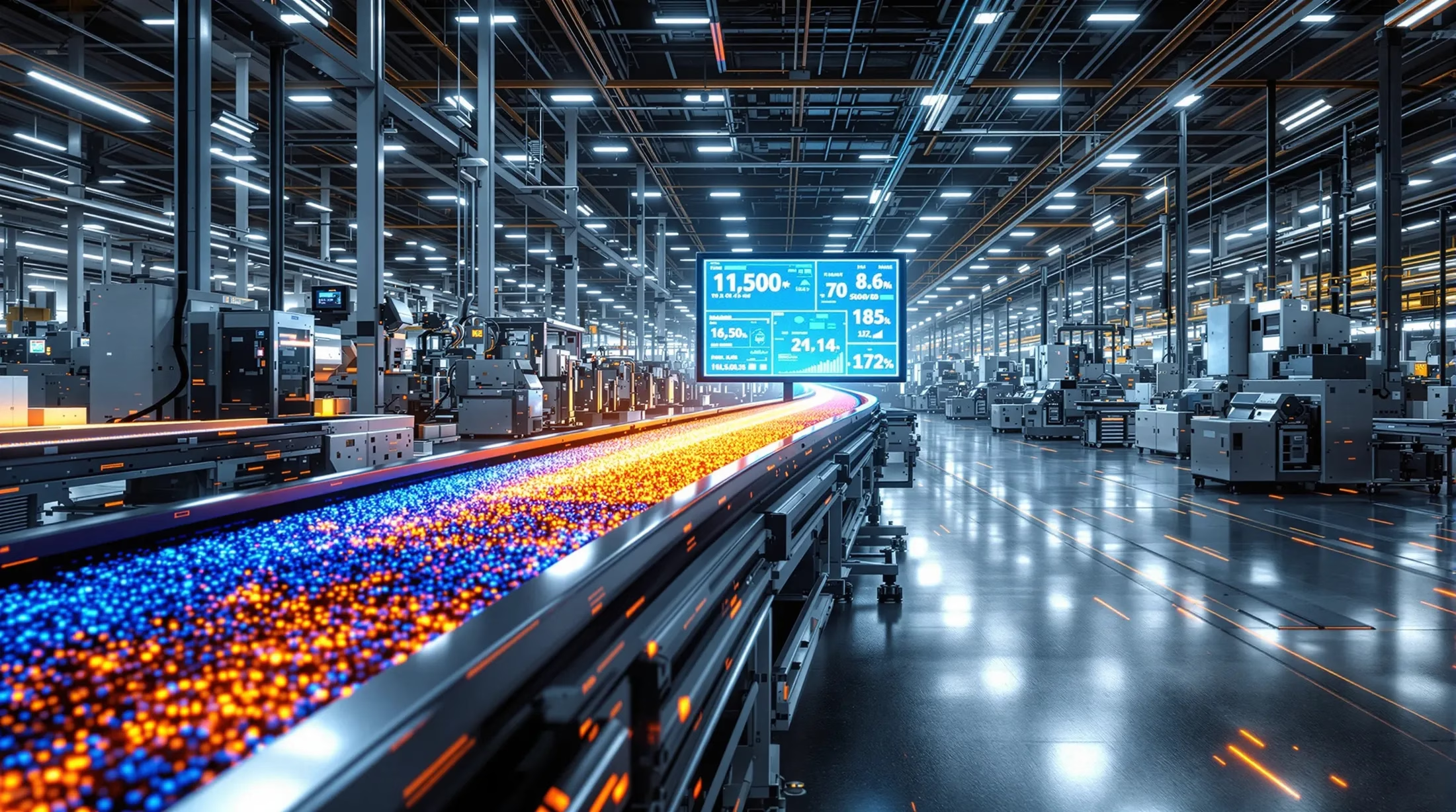
Digital technologies have revolutionized how manufacturers implement and maintain continuous flow processes. Smart sensors throughout production lines collect thousands of data points per minute, creating detailed digital representations of manufacturing operations. This data integrates with manufacturing execution systems (MES) and enterprise resource planning (ERP) platforms, providing real-time performance visualization through comprehensive dashboards. These systems enable swift identification and correction of flow deviations, ensuring production continuity.
- Smart sensors for real-time data collection
- Manufacturing execution systems (MES) integration
- Enterprise resource planning (ERP) platforms
- Real-time performance dashboards
- Automated deviation detection and correction
- Collaborative robots for precision tasks
- Augmented reality work instruction systems
- Automated guided vehicles (AGVs)
Future Trends: Predictive Maintenance
Predictive maintenance represents a transformative advancement in Continuous Flow Manufacturing excellence. Using artificial intelligence and machine learning algorithms, these systems forecast equipment failures before they occur, analyzing patterns in:
- Vibration patterns and frequencies
- Temperature fluctuations
- Sound signature analysis
- Electrical consumption trends
- Performance degradation indicators
The evolution of predictive maintenance is moving toward fully autonomous systems. Advanced analytics platforms now automatically schedule maintenance activities based on production demands, parts availability, and technician workloads. Digital twins enable engineers to simulate maintenance procedures and their impact on production flow before real-world implementation. Meanwhile, augmented reality systems provide maintenance technicians with precise, step-by-step guidance, significantly reducing equipment downtime and enhancing production continuity.
Sustainability and Continuous Flow Manufacturing
| Sustainability Aspect | Improvement Metrics |
|---|---|
| Energy Consumption | 25-30% reduction compared to batch processing |
| Material Waste | 40-60% less scrap and rework |
| Facility Footprint | 30-40% smaller than batch facilities |
Aligning with Modern Efficiency Needs
Modern continuous flow systems integrate lean principles with digital optimization tools, achieving 15-20% carbon footprint reduction while improving productivity metrics. Forward-thinking companies are implementing innovative solutions such as:
- Closed-loop water systems reducing freshwater consumption by 80%
- Energy recovery systems capturing and repurposing production heat
- Resource optimization through digital monitoring
- Circular economy material reclamation processes
- Integrated sustainability metrics tracking
Case Studies and Industry Applications
| Industry Sector | Key Achievements |
|---|---|
| Pharmaceutical | 60% solvent reduction, 40% energy savings, 75% faster production |
| Consumer Electronics | 35% carbon reduction, 50% faster cycle times |
| Food Processing | 25% energy reduction, 70% quality defect improvement |