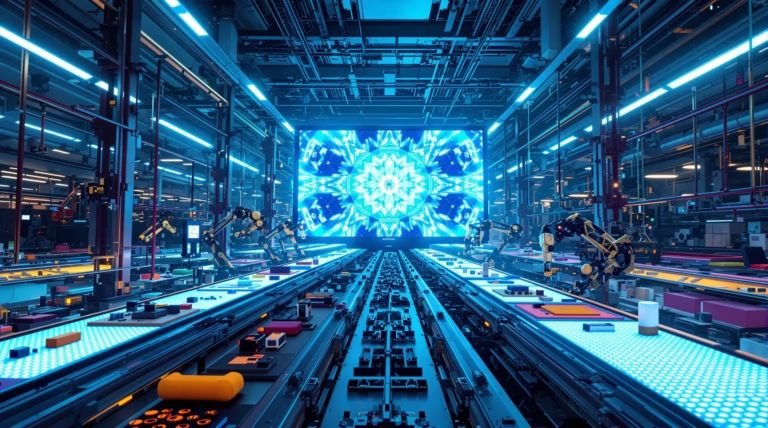

Flexible Manufacturing System: Definition, Benefits, and Applications
In today’s rapidly evolving manufacturing landscape, businesses need production systems that can swiftly adapt to changing market demands. Flexible Manufacturing Systems (FMS) represent a groundbreaking approach that revolutionizes how companies produce goods, offering unprecedented adaptability and efficiency. Let’s explore how these systems transform modern manufacturing operations.
Understanding Flexible Manufacturing Systems
A Flexible Manufacturing System (FMS) represents an advanced production method that adapts rapidly to changes in both product type and quantity. Since their introduction in the 1970s, these systems have revolutionized production capabilities across industries by enabling seamless product switching and volume adjustments without extensive downtime.
Definition and Core Components of FMS
At its core, an FMS is a computer-controlled configuration of semi-independent workstations connected by automated material handling systems. The system’s effectiveness relies on three essential components working in harmony:
- Work Machines – Including CNC machines, robots, tool changers, and inspection stations that perform manufacturing processes
- Material Handling Systems – Responsible for transporting parts between workstations and managing material storage
- Central Control Computer – Coordinates system activities, manages workflows, and monitors overall performance
Types of Flexibility in FMS
| Flexibility Type | Description | Key Benefits |
|---|---|---|
| Machine Flexibility | Ability to modify operations and produce new product types | Minimal retooling, automatic tool changes, adjustable processing parameters |
| Routing Flexibility | Capability to use multiple machines for identical operations | Bottleneck avoidance, equipment failure management, production path optimization |
Benefits of Implementing a Flexible Manufacturing System
While requiring substantial initial investment, FMS implementation delivers significant advantages across various operational aspects. The system creates a foundation for greater machine efficiency and system reliability, enabling swift adaptation to market demands.
Operational Cost Reduction and Productivity Increase
- 15-25% reduction in operational costs
- 20-30% increase in productivity metrics
- Significant reduction in labor costs through automated operations
- Enhanced integration with CAD/CAM systems
- Improved resource utilization and throughput capacity
Quality Improvement and Waste Minimization
FMS excellence in quality control manifests through computer-controlled processing that minimizes human error and variability. The system delivers:
- 30-40% reduction in inventory requirements
- Up to 50% decrease in defect rates
- Enhanced dimensional accuracy and surface finishes
- Real-time quality monitoring and inspection
- Optimized material handling and reduced scrap generation
Challenges and Considerations in FMS Implementation
While Flexible Manufacturing Systems deliver substantial benefits, organizations face several significant implementation challenges. The primary obstacle is the considerable initial investment, ranging from hundreds of thousands to millions of dollars based on system scale and complexity. This substantial capital requirement often prevents small and medium-sized enterprises from adopting FMS technology.
- Extensive pre-planning and system design requirements
- Need for skilled technicians and engineers
- Complex integration of multiple components
- Increased maintenance demands compared to traditional systems
- Workforce challenges in regions with limited technical expertise
Initial Investment and Long-term Benefits
| Investment Aspect | Financial Impact |
|---|---|
| Initial Cost Premium | 30-50% higher than traditional systems |
| Return on Investment Timeline | 2-3 years for cost benefits realization |
| Long-term Ownership Period | 5-10 years for optimal economic benefits |
Despite the substantial upfront costs, well-implemented FMS solutions consistently demonstrate positive returns through reduced labor costs, lower inventory requirements, decreased waste, and improved production efficiency. Industries with high product variation particularly benefit, as FMS eliminates the need for multiple dedicated production lines.
Technical Challenges in FMS Communication
Communication infrastructure presents critical technical hurdles in FMS implementation. The complex network requires robust protocols for seamless information exchange between machines, material handling systems, and central computers. System architects must develop standardized protocols capable of managing diverse equipment while maintaining real-time operations.
- Message collision management and data integrity
- Electromagnetic interference mitigation
- Error detection and correction mechanisms
- Redundant communication pathways
- Integration of legacy equipment with modern controls
Applications of Flexible Manufacturing Systems
FMS technology excels in producing small to medium-sized batches of related products sharing similar manufacturing characteristics. These systems prove particularly valuable for companies requiring a balance between production efficiency and product customization.
| FMS Type | Characteristics |
|---|---|
| Modular FMS | Highest adaptability, allows component reconfiguration |
| Engineered FMS | Tailored automation for specific product families |
| Dedicated FMS | Optimal efficiency for stable product lines |
Industry-Specific Implementations
The automotive sector extensively utilizes FMS for multi-model production lines, incorporating advanced robotics for welding, painting, and assembly operations. These implementations enable rapid response to market demand fluctuations while maintaining production efficiency.
In aerospace manufacturing, FMS technology facilitates precise fabrication of complex components through specialized CNC machining centers. The system’s routing flexibility optimizes expensive equipment usage while maintaining strict quality control protocols. Leading manufacturers like Boeing and Airbus integrate inspection technologies directly into production workflows, ensuring compliance with rigorous safety standards.
Future Trends in Flexible Manufacturing
The evolution of Flexible Manufacturing Systems is accelerating toward hyper-connected, AI-driven production environments. Next-generation FMS implementations increasingly incorporate machine learning algorithms that analyze production data in real-time, optimizing workflows autonomously and predicting maintenance needs before failures occur. These advanced systems enable dynamic switching between different production configurations with minimal human intervention, significantly enhancing manufacturing responsiveness.
- Integration of digital twin technology for virtual process simulation
- Advanced collaborative robots (cobots) working alongside human operators
- Cloud-based manufacturing platforms enabling multi-facility coordination
- Real-time production data analysis through AI algorithms
- Predictive maintenance capabilities powered by machine learning
- Dynamic production configuration switching
| Emerging Technology | Impact on Manufacturing |
|---|---|
| Digital Twin Integration | Reduces downtime and configuration errors through virtual testing |
| Collaborative Robots | Combines automation precision with human problem-solving |
| Cloud Manufacturing | Enables dynamic allocation of production tasks across facilities |
The emergence of cloud-based manufacturing platforms is transforming FMS operations, enabling unprecedented levels of production coordination across multiple facilities. These platforms facilitate the sharing of production capacity, allowing organizations to dynamically allocate manufacturing tasks based on equipment availability and proximity to customers. As these technologies mature, the distinction between different types of manufacturing systems continues to blur, pointing toward a future where adaptive, intelligent production becomes the industry standard.